
EU PPWR & EPR Regulations: Transition Roadmap to Mono-PE Packaging Structure for Exporters
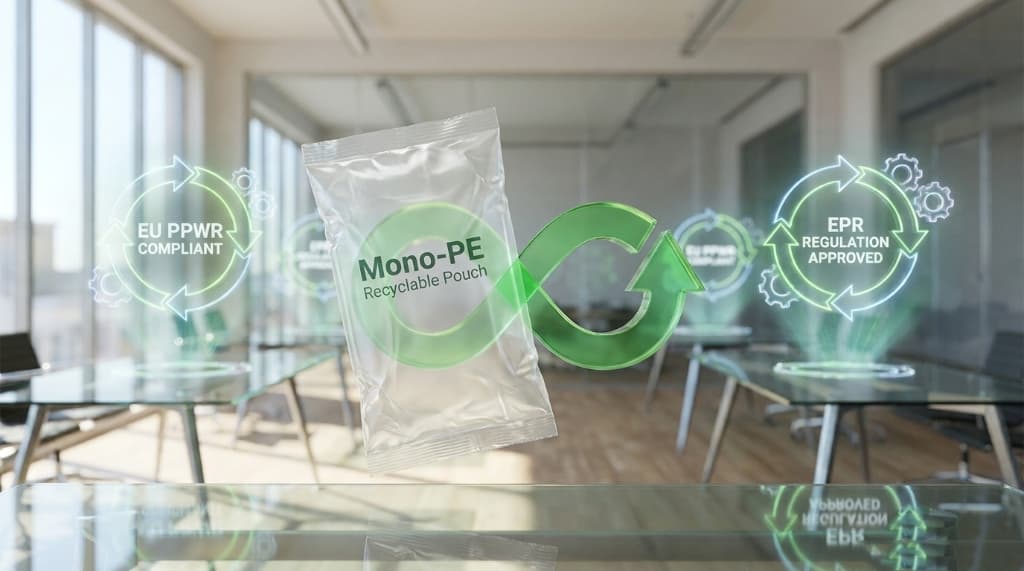
1. Regulatory Framework & Green Transition Pressures in the European Market
EXECUTIVE SUMMARY: The European Union's Packaging and Packaging Waste Regulation (PPWR) and Carbon Border Adjustment Mechanism (CBAM) establish the most rigorous technical standards to date for FMCG, food, and agricultural exporters. Transitioning from multi-material laminates to Mono-PE structures is no longer an optional green initiative, but a mandatory prerequisite for market access.
As the European Union reinforces comprehensive sustainability mandates, the Packaging and Packaging Waste Regulation (PPWR) alongside Extended Producer Responsibility (EPR) schemes are initiating a profound restructuring across the global flexible packaging supply chain.
Under the PPWR timeline, all packaging distributed within the EU must be 100% recyclable at commercial scale (Design for Recycling - D4R) by 2030. Furthermore, legacy multi-material laminates combining distinct polymer families (such as PET/PE, BOPA/PE, or AL/PE) will face prohibitive EPR penalties or outright commercial bans due to inability to undergo mechanical recycling.
| Timeline / Mechanism | Core Technical Requirement | Impact on Exporting Enterprises |
|---|---|---|
| 2026 - 2027 (Transition Phase) | D4R recyclability assessment under RecyClass standards. Mandatory PCR recycled content reporting. | Must audit existing packaging BOM structures and conduct trial runs with Mono-PE materials. |
| 2030 (Mandatory PPWR Milestone) | 100% packaging must attain Recyclability Grade A/B (> 90% single PE polymer purity). | Multi-material packaging (PET/PE, AL/PE) faces maximum EPR penalties or market prohibition. |
| 2035 (Closed-Loop Circular Economy) | Implementation of actual Recycled at Scale verification across all EU member states. | Only pure Polyethylene (Mono-PE) packaging lines qualify for preferential eco-modulation fees. |
2. Mono-PE Structure: Technical Bottlenecks & Breakthrough Solutions
While Mono-PE (100% Polyethylene) represents the gold standard for circular packaging, transitioning from PET/PE to Mono-PE encounters three critical technical hurdles during high-speed automated packaging:
NOVAPLEX® 5-Layer Blown PE Film Solution – The Engineering Bridge
To resolve these bottlenecks, NOVAPLEX® (engineered by DNC Film) developed specialized 5-layer co-extruded PE films specifically designed for Mono-PE lamination structures. By pairing MDO-PE (Machine Direction Oriented PE) or BOPE as the outer print substrate with NOVAPLEX® 5-layer film as the internal sealant layer, packaging achieves optimal synergy:
3. Four-Step Mono-PE Transition Roadmap for Exporters
To assist FMCG brands, food processors, and packaging manufacturers in mitigating transition risks and costs, NOVAPLEX® recommends a structured 4-step implementation plan: