
Selecting Melt Index (MI) and Density for 5-Layer PE Blown Film Optimization
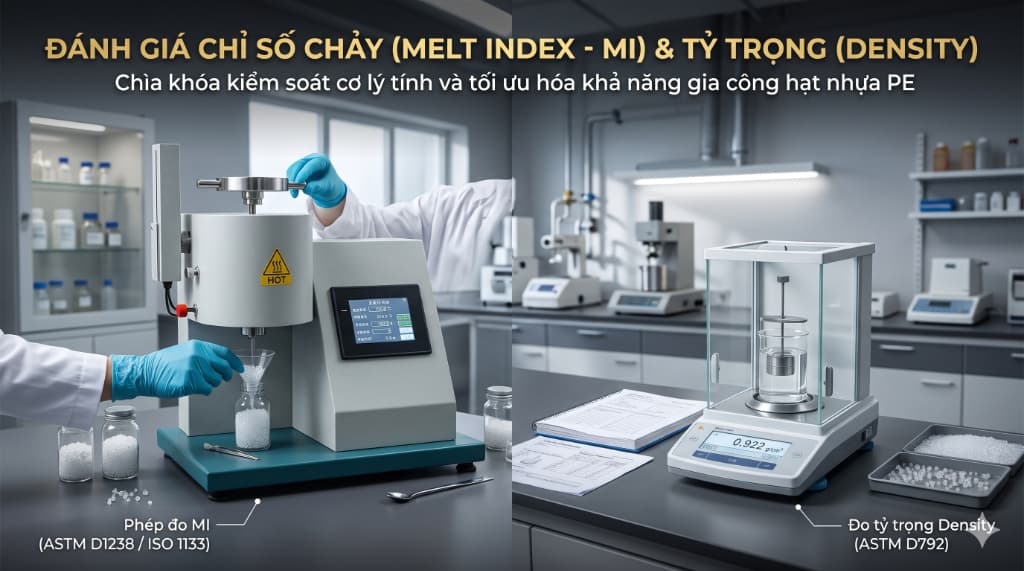
📌 EXECUTIVE SUMMARY: In the flexible packaging industry, Melt Index (MI) and Density serve as foundational parameters governing both blown film processability and final mechanical performance. This comprehensive technical guide analyzes physical-chemical dynamics, formulation trade-offs, and how NOVAPLEX® 5-layer co-extrusion engineering customizes MI and density across distinct layers to achieve superior line output and structural integrity.
1. The Raw Material Blending Challenge in Blown Film Extrusion
Flexible packaging converters and automated packaging plants navigate rigorous compromises: sealant films must offer high puncture resistance, flex-crack endurance, and rapid sealing (Low SIT & high Hot Tack), while maintaining sufficient stiffness to resist elongation and distortion through high-temperature printing and laminating drying ovens. Mastering Melt Index (MI) and Resin Density is essential to resolving these conflicting requirements.
2. Melt Index (MI): Melt Viscosity & Bubble Melt Strength
Melt Index (tested under ASTM D1238 / ISO 1133 at 190°C / 2.16kg, in g/10min) measures the mass of molten resin extruded through a standard capillary die in 10 minutes. MI is inversely proportional to the polymer's weight-average molecular weight (Mw): Lower MI ⟺ Higher Molecular Weight (Mw) ⟺ Greater Melt Viscosity.
3. Density: Polymer Crystallinity & Film Stiffness
Polyethylene density (measured per ASTM D792 / ASTM D1505 in g/cm³) directly reflects the degree of crystallinity in polymer chains, establishing critical mechanical trade-offs:
4. NOVAPLEX® 5-Layer Formulation Matrix: Customizing MI & Density by Layer
Unlike legacy 3-layer blown film systems limited by raw material blending constraints, NOVAPLEX®'s state-of-the-art 5-layer co-extrusion technology permits independent MI and Density optimization across each specific layer (A/B/C/D/E):
| PE Film Application | Target Melt Index (MI) | Target Resin Density | Mechanical & Operational Performance |
|---|---|---|---|
| Deep Freeze (-25°C) & Seafood Packaging | Low MI (0.8 - 1.0 g/10min) | Low Density (0.910 - 0.915 g/cm³) | Sub-zero shatter resistance, Dart Drop Impact > 400g, puncture protection against sharp fish fins. |
| Heavy-Duty Sacks (10kg - 25kg) & Agriculture | Super-Low MI (0.2 - 0.7 g/10min) | High Density (Bimodal HDPE 0.945+) | High pallet stack compression strength, bottom burst prevention, low moisture vapor transmission (WVTR). |
| High-Speed Sealant Liners (VFFS / HFFS) | Medium MI (1.0 - 2.0 g/10min) | Ultra-Low Density (0.902 - 0.912 g/cm³) | Low SIT (88°C - 95°C), Hot Tack > 4.5 N/15mm for immediate hermetic sealing under load. |
| Printable Technical PE Films | Medium MI (0.8 - 1.2 g/10min) | Medium/High Density (0.925 - 0.935 g/cm³) | High flexural modulus, zero thermal stretch in oven tunnels, long-lasting 38-42 dynes/cm corona treatment. |
| Circular Mono-PE Recyclable Structures | Processing-Optimized MI (0.9 - 1.2 g/10min) | Homogeneous Density (0.918 - 0.922 g/cm³) | Seamless lamination with MDO-PE/BOPE, 100% compliant with EU PPWR & EPR D4R standards. |